The one (trade mark) that got away: Taylor v Killer Queen, LLC (No 5) [2023] FCA 364
Our recent success in defending the registration of the Jazz Corner Hotel trade marks had us excited to read this decision between the icon Katy Perry and the Aussie-battler, Katy Perry. The decision is appealed, but it has raised interesting points: the defence of using one’s name is not limited to your legal name but the name you are known by, and this defence can be raised by that person alone –not entities instructed by her.
Read below for our snapshot of the dispute and the court’s decision.
THE ONE THAT GOT AWAY
American pop star Katy Perry and her US-based company Kitty Purry Inc were found liable for infringing Australian clothing designer, Katie Taylor’s registered KATIE PERRY trade mark by selling clothing merchandise in Australia branded with Katy Perry’s stage name.
BACKGROUND
The applicant, Katie Jane Taylor (Taylor) is an Australian clothing designer who has designed and sold clothes under her birth name “Katie Perry” since 2007.
The second respondent, Katheryn Elizabeth Hudson (Hudson), is a singer who adopted the stage name “Katy Perry” for her professional music career and associated commercial activities including the sale of merchandise.
The first, third and fourth respondents, Killer Queen LCC, Kitty Purry Inc and Purrfect Ventures LLC respectively (Associated Companies), are companies owned and controlled by Hudson from which her commercial ventures including the sale and marketing of clothing and merchandise using her stage name.
Timeline of events
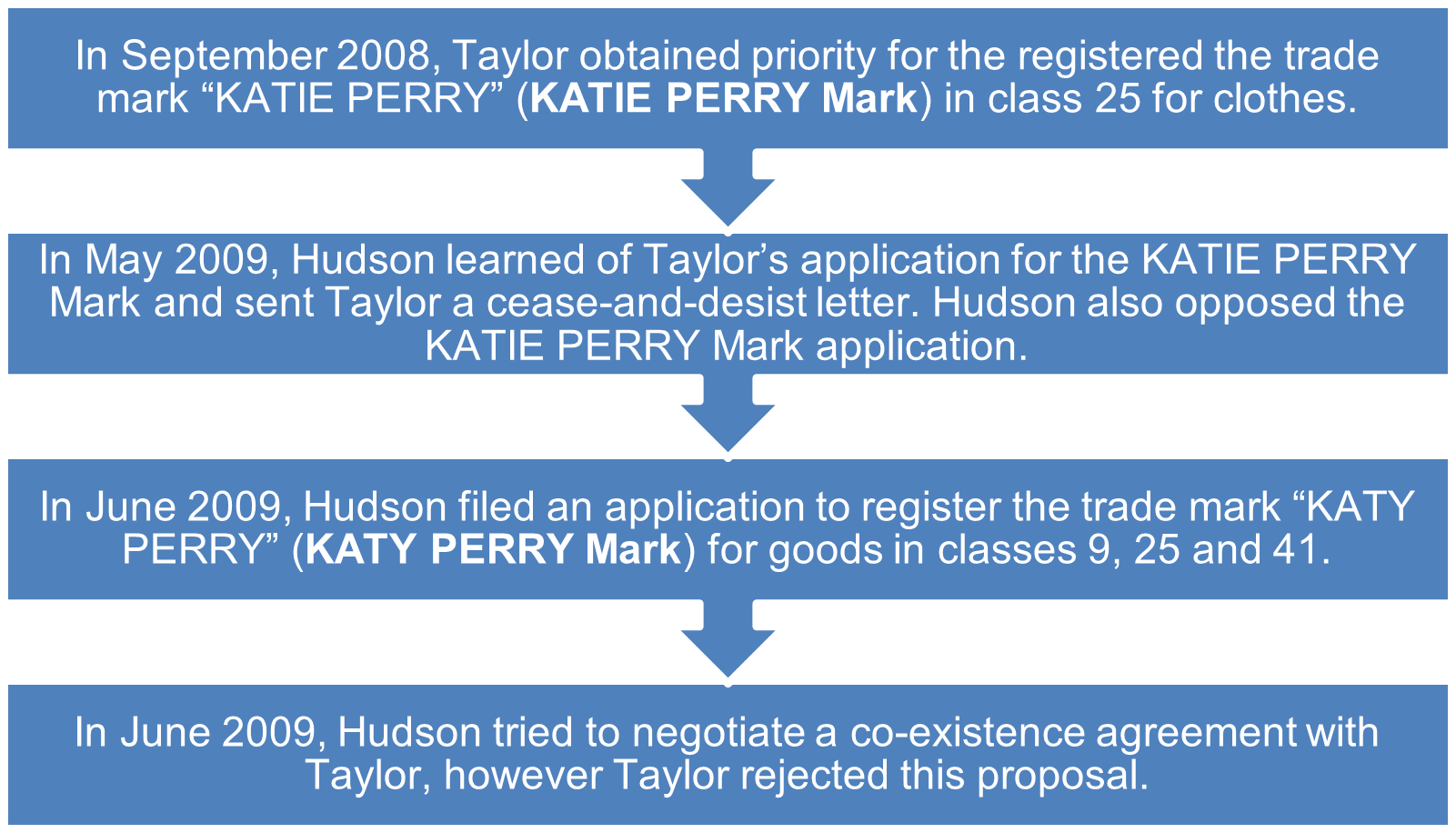
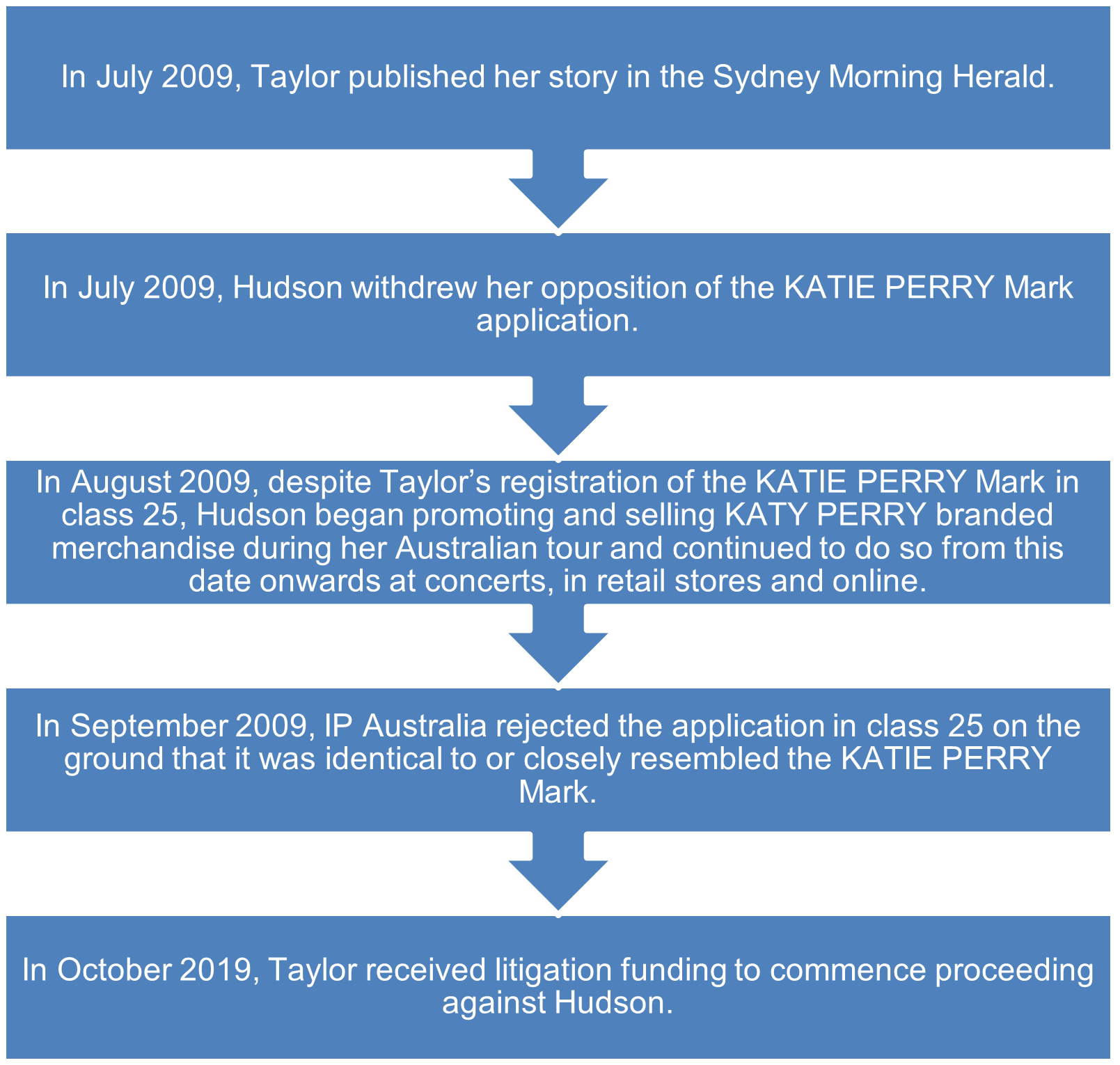
WHAT HAPPENED AT TRIAL?
Taylor bought proceedings against Hudson and the Associated Companies alleging that the respondents had infringed the KATIE PERRY Mark pursuant to s 120 of the Trade Marks Act 1995 (Cth) (Act) by using the KATY PERRY mark which is substantially identical with, or deceptively similar to, the KATIE PERRY mark in the promotion and sale of clothes or goods of the same description.
Hudson and Kitty Purry Inc relied on a defence under s 122(1)(a) of the Act which provides that a person does not infringe a registered trade mark when the person uses their own name in good faith.
Hudson and Kitty Purry Inc also brought a cross-claim seeking cancellation of the KATIE PERRY Mark under s 88 of the Act and amendment of the Register on the grounds that at the time of Taylor’s application to register the trade mark, Hudson had grounds to oppose the registration.
Infringement claim
Justice Markovic accepted the evidence that showed that the sale of clothing with the KATY PERRY mark was used in connection to her career as a music artist which is recognised worldwide, and that it was not likely to deceive or cause confusion with Taylor’s clothing brand.
The court held that the following actions constituted trade mark infringement under s 120 of the Act:
- Hudson in her personal capacity infringed the KATIE PERRY Mark by posting on Twitter and Facebook promoting costumes and merchandise available for sale in Australia online, at Australian pop-up stores or during Australian tours; and
- Kitty Purry Inc. infringed the KATIE PERRY Mark as a joint tortfeasor by advertising, offering for sale and selling clothes and merchandise bearing the KATY PERRY trade mark during the Australian leg of the 2011 Hudson’s Prismatic Tour, at pop-up stores in Sydney and Melbourne and on Bravado website.
A key issue was what constituted the class or nature of the goods that were promoted and sold by each of the respondents. In this case, what type of merchandise sold by the respondents could be considered as infringing goods in relation to Taylor’s trade mark right for “clothes”. The court held that footwear, headgear, caps, hats and headbands, novelty jewellery, bags, decorative masks and decorative headwear were not clothes or goods of the same description as clothes. As such, the respondents were not infringing Taylor’s trade mark by selling these products branded with KATY PERRY in Australia.
Defence: Use of name in good faith
The Federal Court confirmed Taylor’s submissions that only the person who goes by or uses that name has the benefit of the defence under s 122(1)(a) of the Act. In this case that person was Hudson herself and not her Associated Companies, despite these entities being owned and controlled by Hudson.
It was held that it did not matter that ‘Katy Perry’ is Hudson’s adopted or stage name, not her legal name, and that the relevant name is the name by which the person is known. This is a significant finding as it sets the precedent that a person can rely upon the defence under s 122(1)(a) of the Act even if it is their adopted name, nickname or stage name, not their real or legal name.
In respect to ‘in good faith’, the court held that in the circumstances there was no lack of good faith on Hudson’s part to use her stage name in the promotion and sale of goods. The court accepted that Hudson adopted the stage name ‘Katy Perry’ when there was no reputation in the KATIE PERRY Mark and used it in relation to clothes under the honest belief that there was no likelihood of confusion between the marks. As such, Hudson was held to not have committed trade mark infringement in her personal capacity.
Cross-claim
Hudson and Kitty Purry’s cross-claim seeking cancellation of the KATY PERRY Mark was denied by the court. Although, the court was satisfied that Hudson had obtained a reputation in the KATY PERRY mark before the KATIE PERRY Mark was filed, but that reputation was not in relation to clothing but rather in the entertainment and music industry.
The Federal Court’s decision was recently appealed by Hudson to the Full Federal Court of Australia, and we look forward to the Court’s verdict.
Will there be fireworks for Katy Perry?
You can read the full judgment here.
Our recent success in defending the registration of the Jazz Corner Hotel trade marks had us excited to read this decision between the icon Katy Perry and the Aussie-battler, Katy Perry. The decision is appealed, but it has raised interesting points: the defence of using one’s name is not limited to your legal name but the name you are known by, and this defence can be raised by that person alone –not entities instructed by her.
Read below for our snapshot of the dispute and the court’s decision.